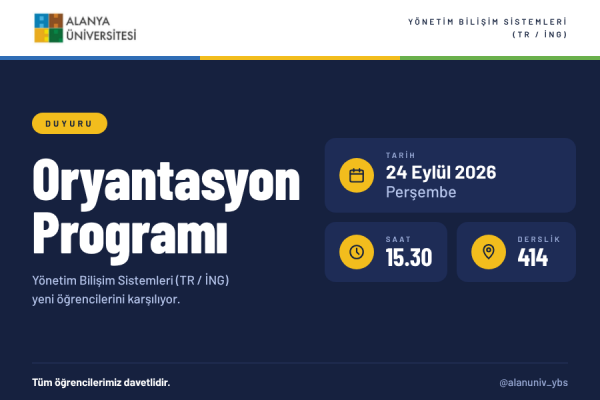

An orientation meeting was organized by the Department of Management Information Systems at Alanya University to support students in adapting to university life and to provide information about the ac...
Lesson Plan and Course Contents
MANAGEMENT INFORMATION SYSTEMS (TURKISH)
Faculty of Economics, Administrative and Social Sciences
CURRICULUM AND COURSE DESCRIPTIONS
You can access the detailed course information packages here.
Last Updated: 05.10.2026
| YEAR 1 | |||||
| SEMESTER 1 | |||||
| Course Code | Course Name | T | P | Cr | ECTS |
| YBS 111 | Introduction to Programming and Algorithms | 3 | 2 | 4 | 5 |
| YBS 103 | Mathematics | 3 | 0 | 3 | 5 |
| YBS 105 | Management Information Systems | 3 | 0 | 3 | 6 |
| YBS 107 | Introduction to Business Management | 3 | 0 | 3 | 5 |
| TKL 111 | Turkish Language I | 2 | 0 | 2 | 2 |
| YTO 111 | Turkish Language for Foreign Students I (Instead of TKL 111) | 2 | 0 | 2 | 2 |
| SEC 101 | Elective Course 1 (University Elective) | 3 | 0 | 3 | 5 |
| ING 111 | General English I | 2 | 0 | 2 | 2 |
| TOTAL | 20 | 30 | |||
| SEMESTER 2 | |||||
| Course Code | Course Name | T | P | Cr | ECTS |
| YBS 102 | Object Oriented Programming | 3 | 2 | 4 | 5 |
| YBS 104 | General Economy | 3 | 0 | 3 | 5 |
| YBS 106 | Statistics | 3 | 0 | 3 | 5 |
| YBS 118 | Computer Hardware | 3 | 0 | 3 | 6 |
| SEC 102 | Elective Course 2 (University Elective) | 3 | 0 | 3 | 5 |
| TKL 112 | Turkish Language II | 2 | 0 | 2 | 2 |
| YTO 112 | Turkish Language for Foreign Students II (Instead of TKL 112) | 2 | 0 | 2 | 2 |
| ING 112 | General English II | 2 | 0 | 2 | 2 |
| TOTAL | 20 | 30 | |||
| YEAR 2 | |||||
| SEMESTER 1 | |||||
| Course Code | Course Name | T | P | Cr | ECTS |
| YBS 201 | Database Management | 3 | 2 | 4 | 6 |
| YBS 203 | System Analysis | 3 | 0 | 3 | 6 |
| YBS 205 | Introduction to Data Science | 2 | 0 | 2 | 6 |
| YBS 207 | Strategic Management | 3 | 0 | 3 | 5 |
| SEC 201 | Elective Course 3 (University Elective) | 3 | 0 | 3 | 5 |
| HIST 211 | Principles of Ataturk and the History of Turkish Revolution I | 2 | 0 | 2 | 2 |
| YTT 211 | Principles of Ataturk and the History of Turkish Revolution for Foreign Students I (Instead of HIST 211) | 2 | 0 | 2 | 2 |
| TOTAL | 17 | 30 | |||
| SEMESTER 2 | |||||
| Course Code | Course Name | T | P | Cr | ECTS |
| YBS 200 | Summer Practice I | 0 | 0 | 0 | 3 |
| YBS 202 | Operations Research | 3 | 0 | 3 | 5 |
| YBS 204 | Financial Accounting | 3 | 0 | 3 | 5 |
| YBS 206 | Decision Support Systems | 3 | 0 | 3 | 5 |
| YBS 208 | Business Intelligence Systems | 3 | 0 | 3 | 5 |
| SEC 202 | Elective Course 4 (University Elective) | 3 | 0 | 3 | 5 |
| HIST 212 | Principles of Ataturk and the History of Turkish Revolution II | 2 | 0 | 2 | 2 |
| YTT 212 | Principles of Ataturk and the History of Turkish Revolution for Foreign Students II (Instead of HIST 212) | 2 | 0 | 2 | 2 |
| TOTAL | 17 | 30 | |||
| YEAR 3 | |||||
| SEMESTER 1 | |||||
| Course Code | Course Name | T | P | Cr | ECTS |
| YBS 301 | Research Methods | 3 | 0 | 3 | 5 |
| YBS 303 | Optimization Techniques | 2 | 2 | 3 | 5 |
| YBS 305 | Financial Management | 3 | 0 | 3 | 5 |
| YBS 307 | Introduction to Artificial Intelligence | 2 | 2 | 3 | 5 |
| SEC 301 | Elective Course 5 (Departmental Elective) | 3 | 0 | 3 | 5 |
| SEC 303 | Elective Course 6 (Departmental Elective) | 3 | 0 | 3 | 5 |
| TOTAL | 18 | 30 | |||
| SEMESTER 2 | |||||
| Course Code | Course Name | T | P | Cr | ECTS |
| YBS 300 | Summer Practice II | 0 | 0 | 0 | 3 |
| YBS 302 | Enterprise Resource Planning | 2 | 2 | 3 | 6 |
| YBS 304 | Project Management | 3 | 0 | 3 | 6 |
| YBS 306 | Computer Networks | 2 | 2 | 3 | 5 |
| SEC 302 | Elective Course 7 (Departmental Elective) | 3 | 0 | 3 | 5 |
| SEC 304 | Elective Course 8 (Departmental Elective) | 3 | 0 | 3 | 5 |
| TOTAL | 15 | 30 | |||
| YEAR 4 | |||||
| SEMESTER 1 | |||||
| Course Code | Course Name | T | P | Cr | ECTS |
| YBS 401 | Management Information Systems Seminar | 3 | 0 | 3 | 7 |
| YBS 403 | System Thinking | 2 | 0 | 2 | 3 |
| YBS 405 | Ethics in Management Information Systems | 3 | 0 | 3 | 5 |
| SEC 401 | Elective Course 9 (Departmental Elective) | 3 | 0 | 3 | 5 |
| SEC 403 | Elective Course 10 (Departmental Elective) | 3 | 0 | 3 | 5 |
| SEC 405 | Elective Course 11 (Departmental Elective) | 3 | 0 | 3 | 5 |
| TOTAL | 17 | 30 | |||
| SEMESTER 2 | |||||
| Course Code | Course Name | T | P | Cr | ECTS |
| YBS 400 | Graduation Project | 0 | 4 | 4 | 10 |
| YBS 402 | Technology and Innovation Management | 3 | 0 | 3 | 5 |
| SEC 402 | Elective Course 12 (Departmental Elective) | 3 | 0 | 3 | 5 |
| SEC 404 | Elective Course 13 (Departmental Elective) | 3 | 0 | 3 | 5 |
| SEC 406 | Elective Course 14 (Departmental Elective) | 3 | 0 | 3 | 5 |
| TOTAL | 16 | 30 | |||
COURSE DESCRIPTIONS
C: CompulsoryE: Elective
T: Theory
P: Practice
Pre.: Prerequisite
Cr: Local Credit
ECTS: European Credit Transfer and Accumulation System
Note: The language of instruction of the Management Information Systems (Turkish) undergraduate program is Turkish. University elective courses (SEC 101, 102, 201, 202) are taken from the university-wide elective course catalogue.
COMPULSORY COURSES
YEAR 1 – FALL SEMESTERYBS 111 Introduction to Programming and Algorithms
T: 3 | P: 2 | Cr: 4 | ECTS: 5
Course Description:
The aim of this course is to enable students to define and understand problems, develop problem-solving skills, grasp the logic of algorithms and programming, become familiar with fundamental algorithms and acquire basic programming skills in a programming language. The course covers the logic of algorithms and programming; problem-solving steps; flowcharts; pseudocode; searching and sorting algorithms; the concepts of variables, constants and basic data types; program control structures (decision and loop structures); and one-dimensional arrays.
Learning Outcomes:
-Understands the concept of an algorithm and the basic elements of programming.
-Expresses algorithms using flowcharts and pseudocode.
-Writes computer programs to solve problems.
YBS 103 Mathematics
T: 3 | P: 0 | Cr: 3 | ECTS: 5
Course Description:
The aim of this course is to provide students with the fundamental mathematical knowledge and skills they will need in their profession. The course covers numbers, sets, equations and inequalities; functions; exponential and logarithmic functions; trigonometric and inverse trigonometric functions; limits and continuity of single-variable functions; the definition and rules of derivatives; applications of derivatives, analysis of functions and curve sketching; computing limits using derivatives; and integrals.
Learning Outcomes:
-Explains basic concepts related to numbers, sets and functions.
-Performs operations with exponential, logarithmic and trigonometric functions.
-Interprets the concepts of limit and continuity and computes limits.
-Applies differentiation rules and uses derivatives in business problems such as optimization and marginal analysis.
-Computes definite and indefinite integrals and uses them in simple applications.
YBS 105 Management Information Systems
T: 3 | P: 0 | Cr: 3 | ECTS: 6
Course Description:
The aim of this course is to teach the importance of information systems and technology in the business world, why and how businesses use information systems, and how business objectives shape information systems and technology. The course covers principles and concepts of business information systems: resource management, customer relationship management, supply chain management, legal and professional issues; the strategic impact of information systems; and project management, including project selection, scheduling, control and evaluation.
Learning Outcomes:
-Defines the basic concepts of management information systems (data, information, system, technology) and explains their importance for businesses.
-Analyzes the information systems used in core business functions such as marketing, production, accounting, finance and human resources, and their contribution to decision-making.
-Explains how integrated enterprise systems such as ERP, CRM and SCM work and the competitive advantages they provide.
-Explains the role of data management, database systems and data warehouses in organizations.
-Illustrates the role of business intelligence and decision support systems in managerial decision-making with examples.
-Identifies basic security threats in information systems and the fundamental cybersecurity measures against them.
-Interprets the impact of current developments such as big data, artificial intelligence, data mining and Industry 4.0 on business management.
-Identifies the information system needs of a simple business problem and proposes a suitable type of system.
YBS 107 Introduction to Business Management
T: 3 | P: 0 | Cr: 3 | ECTS: 5
Course Description:
The aim of this course is to introduce the basic concepts of business, the relationship between a business and its environment, business functions and basic management approaches, thereby giving students a holistic view of business management. The course covers basic business and economic concepts, types of businesses and business formation, business ethics and social responsibility, international business, management, organizing, human resources and employment relations, and basic concepts of production and operations management.
Learning Outcomes:
-Defines basic business and economic concepts.
-Explains types of businesses.
-Defines the concepts of international business.
-Explains human resource management and employer-employee and labor relations.
-Explains management and organizing approaches.
TKL 111 Turkish Language I
T: 2 | P: 0 | Cr: 2 | ECTS: 2
Course Description:
The aim of this course is to help students understand the structure, development and rules of the Turkish language and to develop accurate and effective written and oral expression skills. The course covers language and its characteristics, the relationship between language and culture, the place of Turkish among world languages and its historical development, the phonological and morphological features of Turkish, spelling and punctuation rules, and the principles of composition writing.
Learning Outcomes:
-Explains the importance of language in social and cultural life.
-Describes the historical development of Turkish and its place among world languages.
-Explains the phonological and morphological features of Turkish.
-Applies spelling and punctuation rules correctly.
-Writes well-organized and coherent short texts.
ING 111 General English I
T: 2 | P: 0 | Cr: 2 | ECTS: 2
Course Description:
This course aims to help students improve their reading, listening, speaking and writing skills, as well as their vocabulary and grammar, for their academic and professional studies. The course is designed at A1 level to provide general knowledge of the fundamentals of English.
Learning Outcomes:
-Understands instructions related to everyday arrangements.
-Understands simple, short texts with the help of pictures, drawings and charts.
-Skims short texts and finds relevant information such as who did what and where.
-Gives a short talk on a simple topic.
-Fills in simple forms with personal information.
-Describes places.
-Writes simple sentences about their school, job or where they live.
-Recognizes familiar words and phrases in listening texts.
YEAR 1 – SPRING SEMESTER
YBS 102 Object Oriented Programming
T: 3 | P: 2 | Cr: 4 | ECTS: 5
Course Description:
The aim of this course is to teach the object-oriented programming approach using the Python language and to enable students to develop object-oriented programs. The course covers object-oriented design; classes and objects; class and object methods and attributes; the fundamental concepts of object-oriented programming: encapsulation, abstraction, inheritance and polymorphism; data structures; graphical user interface design; and database operations.
Learning Outcomes:
-Defines the fundamental concepts of object-oriented programming.
-Develops small-scale applications using the object-oriented programming approach.
-Uses appropriate existing libraries when developing applications.
YBS 104 General Economy
T: 3 | P: 0 | Cr: 3 | ECTS: 5
Course Description:
The aim of this course is to identify the main economic problems affecting developing countries and to show how economic analysis can reveal obstacles to development and how these obstacles can be overcome. The course covers the subject matter and basic concepts of economics: scarcity, choice, utility, needs, income and production; supply and demand, elasticity, consumer behavior, firm behavior, market structures, income distribution, national income accounting, inflation, unemployment, and money and banking.
Learning Outcomes:
-Defines and analyzes basic economic concepts.
-Explains the decision mechanisms needed to answer the basic economic questions of what, how and for whom to produce.
-Analyzes market equilibrium.
-Analyzes different market structures.
-Explains the differences between macroeconomics and microeconomics.
-Analyzes macroeconomic problems.
YBS 106 Statistics
T: 3 | P: 0 | Cr: 3 | ECTS: 5
Course Description:
The aim of this course is to teach and apply the basic statistical methods used in the social sciences, together with their assumptions and limitations. The course covers the definition of statistics, basic concepts, measurement scales, data collection, statistical series and graphs, measures of central tendency, measures of dispersion, probability and probability distributions.
Learning Outcomes:
-Collects and organizes data.
-Summarizes series and calculates measures of central tendency and dispersion.
-Performs probability calculations.
-Uses probability distributions.
YBS 118 Computer Hardware
T: 3 | P: 0 | Cr: 3 | ECTS: 6
Course Description:
The aim of this course is to enable students to understand the physical (hardware) and logical (operating system) components of a computer system as a whole, and to grasp how these components work, interact and are managed. The course covers the basic hardware components of computer systems (processor, memory, storage units, input-output devices); the structure, types and basic functions of operating systems; hardware-software interaction, process and memory management, file systems, resource sharing and basic system security; and the use of operating systems and basic troubleshooting.
Learning Outcomes:
-Explains the architecture of the CPU, memory (RAM/ROM), storage units and motherboard.
-Assembles a computer system and configures BIOS/UEFI settings.
-Defines the basic tasks of an operating system (process management, memory management, file system).
-Installs different operating systems (Windows, Linux, etc.), partitions disks and uses the command line.
-Understands the layered relationship between hardware, device drivers, the kernel and user applications.
-Analyzes hardware conflicts and operating system errors and produces solutions.
-Creates secure working environments with regard to user authorization and data privacy.
TKL 112 Turkish Language II
T: 2 | P: 0 | Cr: 2 | ECTS: 2
Course Description:
The aim of this course is to help students understand sentence structure and expression in Turkish and to develop accurate, clear and effective written and oral communication skills for academic and everyday life. The course covers sentence structure, errors of expression, types of written texts (petitions, CVs, reports, articles, essays, etc.), principles of academic writing, citation, oral expression and effective speaking.
Learning Outcomes:
-Identifies the elements of a sentence and types of sentences.
-Detects and corrects errors of expression.
-Writes official texts such as petitions, CVs and reports in accordance with the rules.
-Follows the principles of academic writing and citation.
-Delivers a well-planned and effective presentation to an audience.
ING 112 General English II
T: 2 | P: 0 | Cr: 2 | ECTS: 2
Course Description:
The aim of this course is to build on the basic language skills acquired in General English I up to A1+/A2 level and to develop students' basic reading, listening, speaking and writing skills in everyday and academic contexts. The course covers the past tense, future forms, comparative and superlative adjectives, countable and uncountable nouns, modal verbs, basic communicative functions and related vocabulary.
Learning Outcomes:
-Describes past events using simple sentences.
-Expresses future plans and arrangements.
-Compares people, places and objects.
-Maintains basic dialogues in everyday situations (shopping, invitations, suggestions).
-Reads and understands short, simple texts and writes similar texts.
YEAR 2 – FALL SEMESTER
YBS 201 Database Management
T: 3 | P: 2 | Cr: 4 | ECTS: 6
Course Description:
The aim of this course is to teach the basic concepts of database systems, data modeling and database design principles, and to provide knowledge and practical skills in creating, querying and managing relational databases. The course covers basic concepts; relational database design and normalization; relational algebra; SQL (Structured Query Language); single- and multi-table queries; operators and functions; grouping queries; subqueries; views; and the use of indexes.
Learning Outcomes:
-Explains the basic concepts of database systems and the structure of relational databases.
-Creates appropriate database models by applying normalization rules.
-Designs a relational database by identifying tables, primary and foreign keys and relationships.
-Expresses basic queries using relational algebra operations.
-Creates databases and tables and inserts, updates, deletes and queries data using SQL.
-Develops SQL queries involving filtering, sorting, joins and grouping.
-Performs complex queries using subqueries and views.
-Explains the effect of indexes on performance and creates indexes where appropriate.
YBS 203 System Analysis
T: 3 | P: 0 | Cr: 3 | ECTS: 6
Course Description:
The aim of this course is to explain the analysis phase in the development of information systems and to equip students with the skills to identify user needs, examine existing systems and model requirements for a new system. The course covers system and information system concepts, the systems development life cycle (SDLC), traditional and agile approaches, feasibility analysis, requirements elicitation techniques, process modeling (data flow diagrams), data modeling (entity-relationship diagrams), object-oriented analysis and UML, and requirements documentation.
Learning Outcomes:
-Explains the phases of the systems development life cycle and different development approaches.
-Conducts a technical, economic and operational feasibility assessment for a project.
-Elicits and classifies user requirements using appropriate techniques.
-Models a system using data flow diagrams, entity-relationship diagrams and UML diagrams.
-Prepares and presents a requirements analysis report for a business problem.
YBS 205 Introduction to Data Science
T: 2 | P: 0 | Cr: 2 | ECTS: 6
Course Description:
The aim of this course is to build the foundations of data science and to teach data preprocessing, data reduction, learning approaches and data visualization in a hands-on manner. The course covers data types; data preparation; dealing with missing and noisy data; data reduction and data augmentation; feature and instance selection; outlier removal; discretization; supervised and unsupervised learning; regression modeling; model evaluation; association rules; and data summarization and visualization.
Learning Outcomes:
-Explains the basic concepts of data science.
-Applies data preprocessing, data reduction and data augmentation methods.
-Recognizes approaches to learning from data and selects an appropriate method.
-Evaluates the performance of learning methods using appropriate metrics.
YBS 207 Strategic Management
T: 3 | P: 0 | Cr: 3 | ECTS: 5
Course Description:
Concepts of strategic management such as cash cows, sustainable competitive advantage and core competencies are widely used in today's business world, and the ability to carry out strategic analysis of real business problems has become a valuable skill in many professions such as management consulting, finance and banking. This course aims to teach the tools required for such analyses and to develop students' strategic thinking. The course covers the strategy formulation process, external and internal environmental analysis, SWOT analysis, types of strategies, competitive and functional strategies, strategy implementation and control, and operational and business planning.
Learning Outcomes:
-Explains the basic concepts and process of strategic management.
-Analyzes a firm's internal and external environment using appropriate tools (SWOT, PESTEL, five forces model, etc.).
-Compares strategic options at the corporate, competitive and functional levels.
-Explains basic approaches to strategy implementation and control.
-Analyzes a real business case and develops strategic recommendations.
HIST 211 Principles of Ataturk and the History of Turkish Revolution I
T: 2 | P: 0 | Cr: 2 | ECTS: 2
Course Description:
The aim of this course is to explain to university students the conditions under which the Republic of Turkey was founded, and to foster an understanding of Atatürk's thought, its underlying philosophy and principles, together with contemporary values. The course covers the history of the Turkish revolution under Atatürk's leadership. The reasons for the collapse of the Ottoman Empire are examined, and the founding of the Republic of Turkey from a state that had effectively ceased to exist is evaluated in the light of Atatürk's principles and reforms. The meaning and significance of these principles and reforms are emphasized to shed light on Turkey's recent history, and global problems from the past to the present and their possible solutions are discussed.
Learning Outcomes:
-Evaluates the collapse of the Ottoman Empire and the founding of the Republic of Turkey in their historical context.
-Understands the causes, course and results of the Turkish War of Independence.
-Understands Atatürk's principles and reforms as the cornerstones of the Republic.
YEAR 2 – SPRING SEMESTER
YBS 200 Summer Practice I
T: 0 | P: 0 | Cr: 0 | ECTS: 3
Course Description:
The aim of this course is to enable students to observe the theoretical knowledge gained in their first two years in an organizational setting and to become familiar on site with business processes and the information systems that support them. Students complete an internship at a public or private organization for the period specified in the department's internship directive. During the internship, the organization's structure, core business processes, and the hardware, software and information systems in use are examined; the work carried out is recorded in the internship logbook and presented as a report at the end of the internship.
Learning Outcomes:
-Describes the organizational structure and core business processes of the organization.
-Explains the information systems and technological infrastructure used in the organization.
-Adapts to teamwork in a workplace and takes professional responsibility.
-Presents the work carried out during the internship in a well-organized report.
YBS 202 Operations Research
T: 3 | P: 0 | Cr: 3 | ECTS: 5
Course Description:
The aim of this course is to teach the mathematical modeling of managerial decision problems and their solution with quantitative methods, giving students an optimization-based perspective on decision-making. The course covers the definition and process of operations research, formulating linear programming models, the graphical method, the simplex method, sensitivity analysis and duality, transportation and assignment problems, integer programming, network models, decision analysis, and the use of solvers (such as Excel Solver) in applications.
Learning Outcomes:
-Formulates managerial decision problems as mathematical models.
-Solves linear programming problems using the graphical and simplex methods.
-Interprets the results of sensitivity analysis from a managerial perspective.
-Solves transportation, assignment and network problems with appropriate methods.
-Solves optimization problems with software tools and reports the results.
YBS 204 Financial Accounting
T: 3 | P: 0 | Cr: 3 | ECTS: 5
Course Description:
The aim of this course is to teach the basic concepts, principles and recording procedures of accounting and to help students understand how financial information is generated and reported in businesses. The course covers the definition and functions of accounting, basic accounting concepts, the balance sheet and income statement, the concept and operation of accounts, the Turkish Uniform Chart of Accounts, journal and ledger entries, the operation of asset, liability and income statement accounts, the trial balance, year-end procedures and the preparation of financial statements.
Learning Outcomes:
-Explains the basic concepts and principles of accounting.
-Records business transactions in the journal according to the Uniform Chart of Accounts.
-Prepares the general ledger and trial balance.
-Performs year-end procedures.
-Prepares and interprets, at a basic level, the balance sheet and income statement.
YBS 206 Decision Support Systems
T: 3 | P: 0 | Cr: 3 | ECTS: 5
Course Description:
The aim of this course is to introduce managerial decision-making processes and the information systems that support them, and to equip students with the skills to design, model and use decision support systems. The course covers the decision-making process and types of decisions, the structure and components of decision support systems (DSS), model management, data management, the user interface, multi-criteria decision-making methods (AHP, TOPSIS), group decision support systems, executive information systems, expert systems and artificial intelligence applications in DSS.
Learning Outcomes:
-Explains the decision-making process and types of decisions.
-Describes the structure and components of decision support systems.
-Solves a decision problem with a spreadsheet-based model.
-Applies multi-criteria decision-making methods and interprets the results.
-Designs a simple decision support system prototype for a business problem.
YBS 208 Business Intelligence Systems
T: 3 | P: 0 | Cr: 3 | ECTS: 5
Course Description:
The aim of this course is to introduce the concept, architecture and tools of business intelligence and to enable students to analyze organizational data and present meaningful information to decision makers. The course covers the definition and components of business intelligence, data warehouse concepts and architectures, dimensional modeling (star and snowflake schemas), ETL processes, OLAP and multidimensional analysis, reporting and dashboards, data visualization principles, basic data mining applications, and business intelligence tools (Power BI, Tableau, etc.).
Learning Outcomes:
-Explains the concepts and architecture of business intelligence and its contribution to businesses.
-Designs a dimensional model for a data warehouse.
-Explains ETL processes and implements a simple data preparation process.
-Performs multidimensional analysis using OLAP operations.
-Prepares reports and dashboards with a business intelligence tool and interprets the findings.
HIST 212 Principles of Ataturk and the History of Turkish Revolution II
T: 2 | P: 0 | Cr: 2 | ECTS: 2
Course Description:
The aim of this course is to explain to university students the conditions under which the Republic of Turkey was founded, and to foster an understanding of Atatürk's thought, its underlying philosophy and principles, together with contemporary values. The course covers the history of the Turkish revolution under Atatürk's leadership. The reasons for the collapse of the Ottoman Empire are examined, and the founding of the Republic of Turkey from a state that had effectively ceased to exist is evaluated in the light of Atatürk's principles and reforms. The meaning and significance of these principles and reforms are emphasized to shed light on Turkey's recent history, and global problems from the past to the present and their possible solutions are discussed.
Learning Outcomes:
-Analyzes the political, legal, social and economic transformation of the Republic of Turkey.
-Interprets the policies developed against internal and external threats to modern Turkey in their historical context.
-Relates Atatürk's system of thought and modernization goals to present-day conditions.
YEAR 3 – FALL SEMESTER
YBS 301 Research Methods
T: 3 | P: 0 | Cr: 3 | ECTS: 5
Course Description:
The aim of this course is to teach the basic principles and process of scientific research and to equip students with the skills to define a research problem, choose an appropriate method, and collect, analyze and report data. The course covers science and the scientific method, the research process, research problems and hypotheses, literature review, quantitative and qualitative research designs, sampling, measurement and scale development, validity and reliability, data collection instruments, basic data analysis, research ethics and reporting.
Learning Outcomes:
-Explains the basic principles of the scientific method.
-Defines a research problem and develops corresponding hypotheses or research questions.
-Compares quantitative and qualitative research designs and selects an appropriate design.
-Determines appropriate sampling and data collection methods.
-Prepares a research proposal in accordance with research and publication ethics.
YBS 303 Optimization Techniques
T: 2 | P: 2 | Cr: 3 | ECTS: 5
Course Description:
The aim of this course is to introduce classical and modern optimization techniques and to enable students to model business and information systems problems as optimization problems and solve them with appropriate methods and software tools. The course covers the classification of optimization problems, single- and multi-variable unconstrained optimization, constrained optimization and Lagrange multipliers, nonlinear programming, dynamic programming, combinatorial optimization, heuristic and metaheuristic methods (genetic algorithms, simulated annealing, particle swarm optimization, tabu search), multi-objective optimization, and applications in Python.
Learning Outcomes:
-Models real-life problems in terms of objective functions, decision variables and constraints.
-Solves unconstrained and constrained optimization problems with analytical and numerical methods.
-Compares the strengths and weaknesses of classical and metaheuristic methods.
-Implements basic metaheuristic algorithms and tunes their parameters.
-Interprets Pareto-optimal solutions in multi-objective problems.
YBS 305 Financial Management
T: 3 | P: 0 | Cr: 3 | ECTS: 5
Course Description:
The aim of this course is to introduce the goals and functions of financial management in businesses and to equip students with the basic analytical tools used in investment, financing and working capital decisions. The course covers the goal and functions of financial management, financial markets and institutions, the time value of money, risk and return, valuation of securities, cost of capital, capital budgeting (NPV, IRR, payback period), financial planning, working capital management, dividend policy and financial leverage.
Learning Outcomes:
-Explains the goals and functions of financial management.
-Performs time value of money calculations.
-Interprets the risk-return relationship and values securities.
-Evaluates investment projects using capital budgeting techniques.
-Performs basic analyses related to working capital and financing decisions.
YBS 307 Introduction to Artificial Intelligence
T: 2 | P: 2 | Cr: 3 | ECTS: 5
Course Description:
The aim of this course is to introduce the basic concepts, methods and application areas of artificial intelligence and to equip students with the skills to apply problem-solving, search and machine learning approaches. The course covers the definition and history of artificial intelligence, intelligent agents, state spaces and search algorithms (uninformed and heuristic search), game trees, knowledge representation and inference, fuzzy logic, an introduction to machine learning, the fundamentals of artificial neural networks and deep learning, natural language processing and generative AI, AI ethics, and applications in Python.
Learning Outcomes:
-Explains the basic concepts and application areas of artificial intelligence.
-Formulates problems in a state space and applies an appropriate search algorithm.
-Explains knowledge representation and fuzzy logic approaches.
-Implements and evaluates basic machine learning models in Python.
-Discusses the ethical and social implications of artificial intelligence applications.
YEAR 3 – SPRING SEMESTER
YBS 300 Summer Practice II
T: 0 | P: 0 | Cr: 0 | ECTS: 3
Course Description:
The aim of this course is to enable students to apply the knowledge and skills gained in the department in a real work environment and to gain professional experience by taking an active role in information systems projects. Students complete an internship, preferably in information systems units such as software development, database management, data analysis, network/system administration or ERP, for the period specified in the department's internship directive. The work carried out is recorded in the internship logbook and assessed through a report and presentation at the end of the internship.
Learning Outcomes:
-Takes an active role in the organization's information systems projects.
-Applies the technical knowledge acquired in the department to real business problems.
-Analyzes a business process and develops IT-based improvement proposals.
-Acts in accordance with professional ethics and works effectively within a team.
-Communicates internship work through a written report and an oral presentation.
YBS 302 Enterprise Resource Planning
T: 2 | P: 2 | Cr: 3 | ECTS: 6
Course Description:
The aim of this course is to teach the conceptual foundations, modules and implementation processes of enterprise resource planning (ERP) systems and to equip students with the skills to execute integrated business processes on an ERP system. The course covers the ERP concept and its historical development (MRP, MRP II, ERP), integrated business processes, ERP architecture and modules (finance, procurement, sales and distribution, production, human resources), ERP selection and implementation methodologies, business process reengineering, change management, cloud ERP, and hands-on practice on an ERP system.
Learning Outcomes:
-Explains the conceptual foundations and evolution of ERP systems.
-Explains core business processes and their relationship with ERP modules.
-Executes procurement, sales and production processes on an ERP system.
-Evaluates success factors and risks in ERP selection and implementation.
-Proposes an ERP implementation plan for a business.
YBS 304 Project Management
T: 3 | P: 0 | Cr: 3 | ECTS: 6
Course Description:
The aim of this course is to teach the basic concepts, processes and tools of project management and to equip students with the skills to plan and manage IT projects in terms of scope, time, cost, quality and risk. The course covers the concepts of projects and project management, the project life cycle, project initiation, scope management and work breakdown structures, time management (Gantt, CPM, PERT), resource and cost management, earned value analysis, risk and quality management, stakeholder and communication management, agile project management (Scrum, Kanban), and project management software.
Learning Outcomes:
-Explains the basic concepts and process groups of project management.
-Prepares a work breakdown structure and schedule for a project.
-Calculates the critical path and project duration using CPM/PERT.
-Evaluates project performance using earned value analysis.
-Compares traditional and agile approaches and prepares an appropriate management plan for an IT project.
YBS 306 Computer Networks
T: 2 | P: 2 | Cr: 3 | ECTS: 5
Course Description:
The aim of this course is to teach the basic concepts, architectures and protocols of computer networks and to equip students with basic skills in network design, configuration and troubleshooting. The course covers network concepts and topologies, the OSI and TCP/IP reference models, the physical layer and transmission media, the data link layer and Ethernet, switching and VLANs, IP addressing and subnetting, routing, the transport layer (TCP/UDP), application layer protocols (HTTP, DNS, DHCP), wireless networks, network security fundamentals, and practice with network simulation tools.
Learning Outcomes:
-Explains network types, topologies and layered network architecture.
-Explains the functions of the OSI and TCP/IP layers and their main protocols.
-Performs IP addressing and subnetting.
-Designs and configures a small-scale network in a simulation environment.
-Identifies basic network problems and proposes solutions.
YEAR 4 – FALL SEMESTER
YBS 401 Management Information Systems Seminar
T: 3 | P: 0 | Cr: 3 | ECTS: 7
Course Description:
The aim of this course is to enable students to research a current topic in management information systems based on the literature, report their findings in accordance with academic writing rules and present them effectively. The course covers selecting a seminar topic, literature review, using academic databases, reference management tools, academic writing and citation, presentation preparation and delivery techniques, and student presentations and discussions on current MIS topics such as digital transformation, artificial intelligence, big data, cybersecurity and cloud computing.
Learning Outcomes:
-Selects a current topic in MIS and formulates a research question.
-Conducts a systematic literature review using academic databases.
-Presents findings in a report that follows academic writing and citation rules.
-Presents the work effectively to an audience and discusses it.
-Evaluates other studies from a critical perspective.
YBS 403 System Thinking
T: 2 | P: 0 | Cr: 2 | ECTS: 3
Course Description:
This course aims to help students understand systems and systems concepts, view an organization as a system, and learn the stages of identifying problems, analyzing a system, designing a new system and preparing it for implementation. The course covers the definition of a system, the hierarchy of systems, the principles of the systems approach, basic systems concepts, the system as a black box; systems analysis, design, preparation and implementation; soft systems methodology and its steps; systems thinking, feedback loops and behavior patterns.
Learning Outcomes:
-Approaches organizations from a systems perspective using systems concepts.
-Identifies problems and analyzes the system.
-Develops solutions that eliminate or mitigate problems.
-Builds models and designs new systems.
-Plans the preparation and implementation of designed systems.
YBS 405 Ethics in Management Information Systems
T: 3 | P: 0 | Cr: 3 | ECTS: 5
Course Description:
The aim of this course is to introduce the ethical, legal and social issues arising from the use of information technologies and to develop students' awareness of professional ethics and ethical decision-making skills. The course covers the concept of ethics and ethical theories, computer ethics and professional codes of ethics (ACM, IEEE), privacy and the protection of personal data (KVKK, GDPR), intellectual property and software licenses, cybercrime and Turkish Law No. 5651, ethics in information security, the digital divide, AI ethics and algorithmic bias, information ethics in the workplace, and case analyses.
Learning Outcomes:
-Explains basic ethical theories and the scope of computer ethics.
-Interprets professional codes of ethics and defines professional responsibilities.
-Explains the legal regulations on personal data protection and intellectual property.
-Analyzes ethical dilemmas created by information technologies.
-Develops a well-reasoned ethical decision for a given case.
YEAR 4 – SPRING SEMESTER
YBS 400 Graduation Project
T: 0 | P: 4 | Cr: 4 | ECTS: 10
Course Description:
The aim of this course is to enable students to integrate the knowledge and skills acquired throughout their undergraduate studies and, under the supervision of an advisor, to complete an information system solution to a real business problem through analysis, design, development and reporting. The course covers selecting the project topic, the project proposal, requirements analysis, system design (database, interface, architecture), software development or a data analytics application, testing, documentation, writing the project report and presenting it before a jury.
Learning Outcomes:
-Defines a real business problem and prepares a comprehensive project proposal.
-Carries out requirements analysis and system design for the problem.
-Develops a working software or analytics solution using appropriate technologies.
-Tests and evaluates the developed solution.
-Documents the project in a report following academic rules and defends it before a jury.
YBS 402 Technology and Innovation Management
T: 3 | P: 0 | Cr: 3 | ECTS: 5
Course Description:
The aim of this course is to explain the role of technology and innovation in the competitiveness of businesses and to equip students with the skills to manage innovation processes, develop technology strategies and turn new ideas into business models. The course covers the concepts of technology and innovation, types of innovation, the technology life cycle and S-curve, disruptive innovation, open innovation, the innovation process and its management, R&D management, technology transfer, intellectual property rights, the business model canvas, design thinking, technology entrepreneurship, national innovation systems and support programs (TÜBİTAK, KOSGEB).
Learning Outcomes:
-Explains the basic concepts of technology and innovation and the types of innovation.
-Interprets the technology life cycle and disruptive innovation through cases.
-Explains the innovation process and its management.
-Describes intellectual property rights and support mechanisms.
-Turns a technology-based idea into a business model using the business model canvas.
ELECTIVE COURSES
(DEPARTMENTAL)
(DEPARTMENTAL)
| Course Code | Course Name | Prerequisite | T | P | Cr | ECTS |
| SEC 301 | Human Resources Management | - | 3 | 0 | 3 | 5 |
| SEC 303 | Digital Marketing | - | 3 | 0 | 3 | 5 |
| SEC 302 | Research Methods | - | 3 | 0 | 3 | 5 |
| SEC 304 | Business Intelligence Systems | - | 3 | 0 | 3 | 5 |
| SEC 401 | Financial Statement Analysis | - | 3 | 0 | 3 | 5 |
| SEC 403 | Feasibility Study | - | 3 | 0 | 3 | 5 |
| SEC 405 | Information Security Management | - | 3 | 0 | 3 | 5 |
| SEC 402 | Game Theory | - | 3 | 0 | 3 | 5 |
| SEC 404 | Regional Development and Sustainability | - | 3 | 0 | 3 | 5 |
YEAR 3 – FALL SEMESTER
SEC 301 Human Resources Management
T: 3 | P: 0 | Cr: 3 | ECTS: 5
Course Description:
The aim of this course is to introduce the core functions and current approaches of human resource management and to enable students to evaluate HR processes and the information systems that support them. The course covers the development of human resource management, job analysis and design, human resource planning, recruitment and selection, training and development, performance appraisal, compensation management, career management, occupational health and safety, employment relations, human resource information systems and digital HR practices.
Learning Outcomes:
-Explains the core functions of human resource management.
-Conducts a job analysis and prepares a job description.
-Compares recruitment, selection and performance appraisal methods.
-Explains basic approaches to compensation and career management.
-Evaluates the contribution of human resource information systems to HR processes.
SEC 303 Digital Marketing
T: 3 | P: 0 | Cr: 3 | ECTS: 5
Course Description:
The aim of this course is to introduce the basic concepts, channels and measurement methods of digital marketing and to equip students with the skills to develop a data-driven digital marketing strategy. The course covers marketing and digital marketing concepts, the digitalization of consumer behavior, websites and user experience, search engine optimization (SEO) and search engine marketing (SEM), social media marketing, content marketing, e-mail marketing, mobile marketing, e-commerce, web analytics, and ethical and legal regulations in digital marketing.
Learning Outcomes:
-Explains the basic concepts and channels of digital marketing.
-Evaluates SEO, SEM and social media marketing practices.
-Interprets basic web analytics metrics.
-Prepares a data-driven digital marketing plan for a business.
-Explains ethical and legal responsibilities in digital marketing.
YEAR 3 – SPRING SEMESTER
SEC 302 Research Methods
T: 3 | P: 0 | Cr: 3 | ECTS: 5
Course Description:
The aim of this course is to teach the basic principles and process of scientific research and to equip students with the skills to define a research problem, choose an appropriate method, and collect, analyze and report data. The course covers science and the scientific method, the research process, research problems and hypotheses, literature review, quantitative and qualitative research designs, sampling, measurement and scale development, validity and reliability, data collection instruments, basic data analysis, research ethics and reporting.
Learning Outcomes:
-Explains the basic principles of the scientific method.
-Defines a research problem and develops corresponding hypotheses or research questions.
-Compares quantitative and qualitative research designs and selects an appropriate design.
-Determines appropriate sampling and data collection methods.
-Prepares a research proposal in accordance with research and publication ethics.
SEC 304 Business Intelligence Systems
T: 3 | P: 0 | Cr: 3 | ECTS: 5
Course Description:
The aim of this course is to introduce the concept, architecture and tools of business intelligence and to enable students to analyze organizational data and present meaningful information to decision makers. The course covers the definition and components of business intelligence, data warehouse concepts and architectures, dimensional modeling (star and snowflake schemas), ETL processes, OLAP and multidimensional analysis, reporting and dashboards, data visualization principles, basic data mining applications, and business intelligence tools (Power BI, Tableau, etc.).
Learning Outcomes:
-Explains the concepts and architecture of business intelligence and its contribution to businesses.
-Designs a dimensional model for a data warehouse.
-Explains ETL processes and implements a simple data preparation process.
-Performs multidimensional analysis using OLAP operations.
-Prepares reports and dashboards with a business intelligence tool and interprets the findings.
YEAR 4 – FALL SEMESTER
SEC 401 Financial Statement Analysis
T: 3 | P: 0 | Cr: 3 | ECTS: 5
Course Description:
The aim of this course is to teach the basic techniques used in analyzing financial statements and to equip students with the skills to interpret a company's financial position and performance. The course covers the types and content of financial statements, the objectives of financial analysis, comparative statement analysis, common-size analysis, trend analysis, ratio analysis (liquidity, financial structure, activity and profitability ratios), funds flow and cash flow statements, DuPont analysis and the prediction of financial failure.
Learning Outcomes:
-Explains the structure of financial statements and the objectives of financial analysis.
-Applies horizontal, vertical and trend analyses.
-Calculates and interprets financial ratios.
-Prepares funds flow and cash flow statements.
-Analyzes the financial statements of a real company and prepares an evaluation report.
SEC 403 Feasibility Study
T: 3 | P: 0 | Cr: 3 | ECTS: 5
Course Description:
The aim of this course is to teach the process of preparing and evaluating feasibility studies for investment projects and to equip students with the skills to assess projects from market, technical, financial and economic perspectives. The course covers the concepts of investment and project, pre-feasibility and feasibility stages, market research and demand forecasting, capacity and site selection, technical analysis, investment cost and working capital, financing plans, revenue-expense projections, static and dynamic evaluation methods (NPV, IRR, payback period), sensitivity and risk analysis, and social cost-benefit analysis.
Learning Outcomes:
-Explains the purpose and stages of a feasibility study.
-Performs market analysis and demand forecasting for a project.
-Evaluates capacity, site and technical choices.
-Analyzes investment projects using financial evaluation methods.
-Prepares and presents a feasibility report for an investment idea.
SEC 405 Information Security Management
T: 3 | P: 0 | Cr: 3 | ECTS: 5
Course Description:
The aim of this course is to teach the basic concepts of information security and the processes of organizational information security management, and to equip students with the skills to conduct risk assessments and develop security policies. The course covers the principles of confidentiality, integrity and availability, threats and vulnerabilities, information security management systems (ISO/IEC 27001), risk assessment and management, security policies, access control and authentication, fundamentals of cryptography, network and application security, social engineering, incident response, business continuity and disaster recovery, and KVKK and compliance.
Learning Outcomes:
-Explains the basic concepts of information security and types of threats.
-Explains the structure of the ISO/IEC 27001 information security management system.
-Conducts a risk assessment for an organization.
-Proposes an information security policy suitable for an organization.
-Explains the basic steps of incident response and business continuity planning.
YEAR 4 – SPRING SEMESTER
SEC 402 Game Theory
T: 3 | P: 0 | Cr: 3 | ECTS: 5
Course Description:
The aim of this course is to teach the basic concepts and methods of game theory used to analyze decision situations involving strategic interaction, and to equip students with the skills to model economic and managerial problems as games. The course covers the basic concepts of game theory, strategic-form games, dominant strategies, Nash equilibrium, mixed strategies, zero-sum games, sequential games and backward induction, repeated games and cooperation, games of incomplete information, bargaining and auction theory, oligopoly models and business applications.
Learning Outcomes:
-Explains the basic concepts of game theory.
-Models strategic interaction situations as games.
-Finds Nash equilibria in pure and mixed strategies.
-Solves sequential games using backward induction.
-Applies game theory to market competition, bargaining and auction problems.
SEC 404 Regional Development and Sustainability
T: 3 | P: 0 | Cr: 3 | ECTS: 5
Course Description:
The aim of this course is to introduce the concepts, theories and policies of regional development and sustainability and to equip students with the skills to analyze regional development disparities and develop policy proposals within a sustainable development framework. The course covers the concepts of growth, development and sustainable development, theories of regional development, regional disparities and their measurement, regional development policies and development agencies in Turkey, local development and clustering, the United Nations Sustainable Development Goals, environmental, economic and social sustainability, smart cities and the role of digital technologies in development, and tourism and regional development (the case of Alanya).
Learning Outcomes:
-Distinguishes between the concepts of growth, development and sustainable development.
-Explains and compares theories of regional development.
-Analyzes regional development disparities using indicators.
-Evaluates regional development policies and institutions in Turkey.
-Develops a policy proposal for sustainable development in a region.
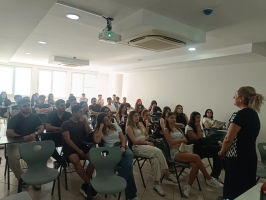
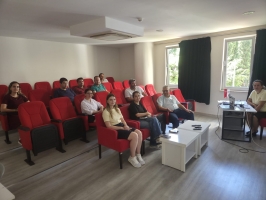
The Department of Management Information Systems at Alanya University organized an external stakeholder meeting to enhance educational activities, strengthen collaboration with industry, and promote e...

Our department participated in the 7th International Week organized by Alanya University under the theme “Voices of Erasmus+”.

5 Aralık 2025 tarihindeki Akdeniz Bilişim Zirvesine bölüm olarak katılım sağladık.